
Cameron
Gawley.
Twenty years building consumer brands. A double exit as agency CEO. Now co-founder and managing partner of FlightPlan Ventures, where we put capital and a full operating team behind founders instead of sending them an invoice.
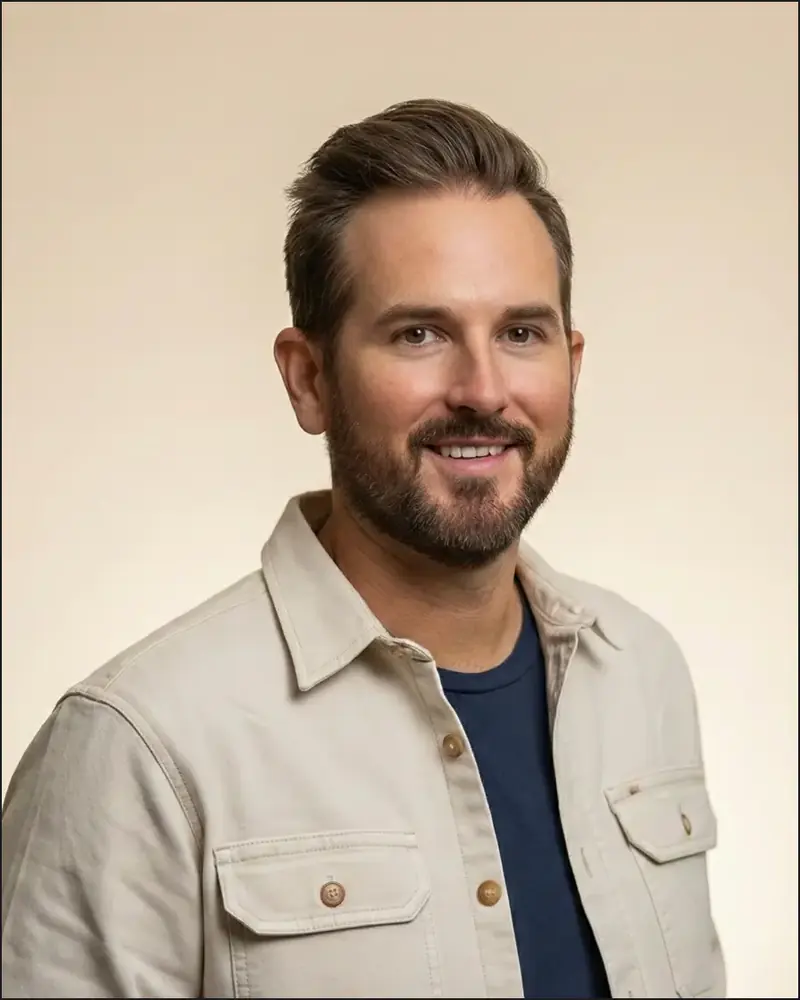
Cameron Gawley is a Dallas-based operator and brand builder. He is Co-Founder and Managing Partner of FlightPlan Ventures, a venture studio that funds and operates early-stage consumer brands, and the founder of GLiTCH Candy, the anchor brand of the portfolio. He takes ownership in the brands he builds rather than billing retainers.
Most consumer brands fail. Almost never on product.
They fail because the founder is alone.
You do not die from a lack of vision. You die from a lack of infrastructure. Acquisition costs climb, operations break the second you get real traction, and you are making the biggest decisions of the company's life without the team, the systems, or the data to execute them.
Most first-time founders treat the parts they enjoy, the product and the story, as the actual work. The math, the distribution and the operations get filed as admin to handle later.
Five seats. One job.
We are building the next billion dollar candy brand. We looked at the candy aisle and realized it has been mid since 2003. Everyone accepted that candy had to destroy you, and the healthy alternatives tasted like cardboard or packed 22g of sugar under a green label. So we fixed it. GLiTCH is the cheat code that should have always existed. Protein-infused, better-for-you candy that actually tastes like the stuff you grew up on. With 11g of protein, 23g of fiber and 2g of sugar per bag, we did not disrupt the industry. We just stopped compromising. Your 10-year-old self would be very proud of your macros today.
glitchcandy.co ↗The gap in this market was never capital. It was execution. We put capital and a twenty-person operating team behind consumer founders, stand the brand up in 120 days, and stay on as the growth partner. Nearly every brand we look at comes through a relationship I built long before there was a deal to talk about. Your network really is your net worth.
A decision engine for consumer founders, not another course. The frameworks I use inside portfolio brands, made usable by operators running their own.
I came in as fractional CMO, built the brand DNA from the ground up, and scaled it from zero to a $29M run rate in eighteen months. Today I stay involved on partnerships.
Direct coaching for three brands a quarter. That cap is the point. Usually a founder stuck between stages who needs the diagnosis before the spend.
I spent eleven years building everyone else's dream.
From 2010 to 2021 I co-founded and ran BuzzShift as CEO, one of the fastest growing DTC and CPG agencies in the country. We sold it in 2016, bought it back in 2017, and sold again to private equity in 2021. A double exit on the same company.
A decade of building other founders' brands teaches you exactly where the model breaks. You do the best work of your life, hand over the deck, and watch it die in a folder because nobody inside the company owned the outcome. The invoice cleared either way.
So we stopped selling the work and started owning it. Same team, same playbook, different incentive. Now we build brands we have equity in, including our own.
Strategy without stage is guesswork.
Most brands do not fail on product. They fail because they scaled the wrong thing at the wrong stage. Everything below exists to answer one question: what is the job right now.
Product-market fit, unit economics, the core story. Manual on purpose.
Repeat purchase, stable ops, one acquisition channel that actually works.
An acquisition engine instead of ad spend. Automation. First real leadership.
Margin expansion, accountability, dashboards people actually read.
New channels, capital strategy, exit readiness. The boring part that pays.
Falling in love with the product before you understand the math is exactly how brands die. Beautiful packaging does not save you when your MOQ forces 50,000 units into a warehouse and COGS eats 40% of margin before a single box ships. We build the model before we build the brand.
You do not have a traffic problem. You have a trust problem. If people land and do not buy, the answer is not another round of ad creative. The offer is not clear. Confusion kills conversion faster than anything, and if it does not land on a stranger instantly, it does not work.
In most categories the products are good enough. You are not competing on features, you are competing on perception. If the brand feels like everyone else, it will perform like everyone else. Most founders are one positioning shift from winning. Finding that shift is the job.
Growth does not create problems, it exposes them. Scaling before you have earned it just breaks things faster. The brands that win build clean data, inventory visibility and fulfillment before they need it, then seed product into thousands of the right hands and can actually absorb the demand.
Founders write briefs for the customer they wish they had, the one they picture at a dinner party. That person may exist, but acquiring them breaks your CAC model by month two. I care about the customer who will buy at scale, not the one who validates your taste.
Attention is rented. Brand is owned. When someone is ready to buy they should not open five tabs to compare you. They come straight to you and they come back, which is where the business actually is. You do not need a better product. You need a sharper story.
This is why I take equity instead of retainers. Aligned incentives beat good intentions every single time.
Headcount is the easiest way to look busy and the fastest way to get slow. Build the seat before you fill it.
The work that compounds is unglamorous and nobody posts about it. Do it anyway, for longer than feels reasonable.
A product competes on price and features. A brand competes on identity, story and community. Here is the uncomfortable version: every product is a commodity, no matter how good you think your formulation is. Someone can copy it, and if it sells, someone will. What cannot be copied is the brand around it. A product is something people buy. A brand is something people belong to, and that feeling is engineered, not accidental.
Trying to scale before they deserve to. They get one channel working, usually paid social, and immediately pour gas on it while the foundation is still weak. Soft retention, unclear positioning, no real story. Scaling just exposes every crack faster. The second biggest mistake is building for the customer they wish existed instead of the one who will actually buy at scale. Those two together will drain your runway in six months.
I will tell you. Directly. After twenty years the kindest thing you can do for a founder is tell them the truth early. If the positioning is wrong, if the unit economics do not work, if the market is not there, I would rather have that conversation in month two than month twelve. I am not here to string you along.
We do not just give advice, we build with you. A traditional VC writes the check and shows up for board meetings. An agency charges a retainer and optimizes ad spend. We take equity and deploy a full operating team, brand, growth, lifecycle, content, from week one. We are inside the business, not watching from outside.
Equity, almost always. I take ownership and put my team inside the business, so I only win when the brand wins. Separately I coach three brands a quarter, directly, and that number is capped on purpose. Coaching gets you clarity. The full partnership gets you execution. Most brands need both, but you do not have to start with both.
We built GardenCup from zero to $29M in DTC sales on Shopify in eighteen months. The short version: we got the positioning right before spending a dollar on ads, built a retention engine from day one, and refused to be everything to everyone. We picked a lane, owned it completely, and scaled what was already working. No magic. Clarity, systems, and relentless execution.
Ads, platforms, algorithms. You control none of them, and the moment you stop paying the traffic stops. Your brand is the asset that compounds. It is what brings people back without a retargeting ad, what makes customers tell their friends, and what keeps you defensible when a competitor shows up with a bigger budget. Building a brand is slower than buying attention. It is also the only part that lasts.
Yes, and some of my best work happens here. Brands get into retail and then realize their DTC infrastructure is broken, because wholesale velocity was masking a weak direct business. If you are in retail and DTC is underperforming, that is a positioning and systems problem, not a channel problem. We fix the engine so both sides work.
Anywhere from a formula in your kitchen to eight figures. The track changes, the answer to whether it is a fit does not. What matters is whether the brand deserves to exist and whether you can execute.
Depends on the track. Roughly 20 to 40% on brands we originate, 30 to 50% or more on accelerator deals, and majority when we are building the entire thing from scratch.
Because the model has to work on my own money first, and because the candy aisle has not had a real idea in twenty years. GLiTCH is protein-infused candy, 11g of protein, 23g of fiber and 2g of sugar per bag, built from a blank page by the same team that backs outside founders, and we are building it to be the next billion dollar candy brand.
Yes. We build the capital strategy, run our own SPVs deal by deal, and help brands raise the round when they are actually ready for it rather than when they are out of runway.
Let's figure out what you actually have.
No deck required. Tell me what you are building and where it is stuck, and I will tell you straight whether we are the right partner for it.
not a product.